Tracking — were your verdicts right?
Last updated: 2026-08-29
This is jini's most distinctive feature. Every verdict you record is checked against the market to verify whether it was right. Correct calls and wrong calls both stay on the record.
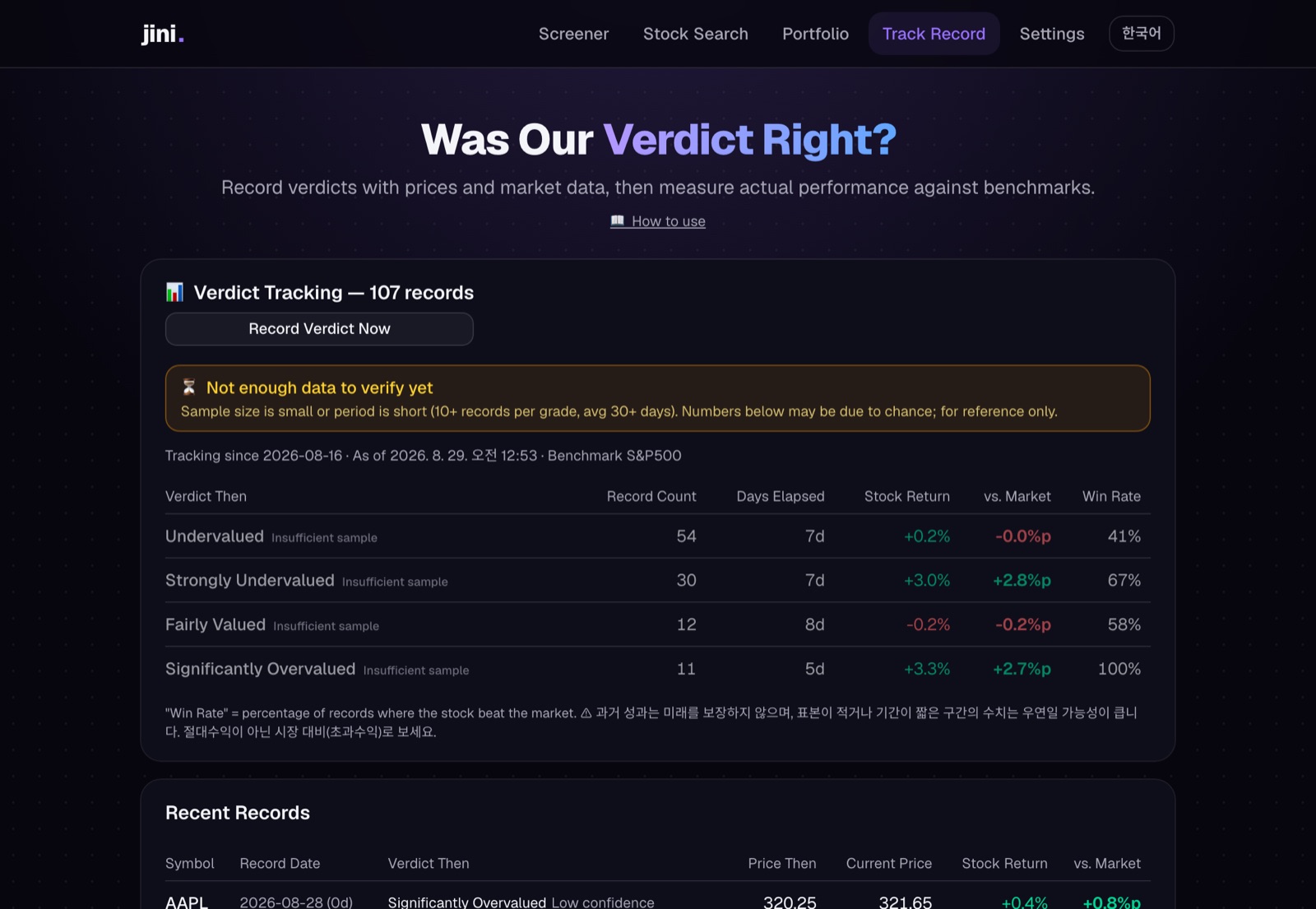 Tracking page — per-verdict aggregates and the small-sample warning
How it works: record and compare
When are verdicts recorded?
- Manually: click "[Record Verdict Now]" and that day's verdict, price, and S&P 500 close are saved
- Automatically: the nightly batch (daily) records automatically
Clicking multiple times on the same day does not duplicate. One stock, one verdict per day.
What gets saved?
A snapshot of every stock in your portfolio:
- Verdict that day: Strongly Undervalued through Significantly Overvalued
- Price that day: closing price on record date
- Market that day: S&P 500 close
- Performance since: actual stock change + market change
Reading the tracking page
Part 1: verdict-by-verdict summary table
Verdicts are grouped to compare how each kind performed.
What each column means
| Column | Meaning |
|---|---|
| Verdict Then | "Strongly Undervalued" / "Undervalued" / "Fairly Valued" etc. |
| Record Count | How many times this verdict was recorded |
| Days Elapsed | Average days since verdict was recorded |
| Stock Return | Record price → now (includes overall market gains) |
| vs. Market | Excess return (%p) — this is the real metric |
| Win Rate | Of this verdict's records, what % beat the market? |
The difference: "Stock Return" vs. "vs. Market"
Stock Return +10%: the stock went up 10% (but if S&P 500 went up 15%, the stock actually lagged the market by 5%p)
vs. Market -5%p: underperformed the market by 5 percentage points (this is true skill)
Example:
- Stock A recorded at 100 → now 110 (return +10%)
- S&P 500 over same period +15%
- Excess return = +10% − 15% = −5%p ← verdict was wrong
Opposite case:
- Stock B recorded at 100 → now 105 (return +5%)
- S&P 500 over same period +2%
- Excess return = +5% − 2% = +3%p ← verdict was right
Part 2: Insufficient Sample Warning
Very important. Never ignore it.
When this warning is active, the numbers below are unreliable. Why?
- Fewer than 10 records: if "Undervalued" was recorded only 3 times, all 3 could have been wrong or lucky
- Average less than 30 days: three weeks of data cannot answer "is this verdict good?"
- When active: it says "Not enough data to verify yet"
This warning protects you from mistaking luck for skill on small samples.
Part 3: Recent records (by individual stock)
All records in chronological order.
| Item | Meaning |
|---|---|
| Symbol | ticker |
| Record Date | the day verdict was recorded |
| Verdict Then | that day's verdict |
| Price Then | closing price on record date |
| Current Price | price now |
| Stock Return | change since record date |
| vs. Market | excess return (%p) |
As you scan this table:
- ✓ Excess return positive = verdict was right
- ✓ Excess return negative = verdict was wrong (or unlucky)
- ✓ Recent records consistently negative = verdicts are deteriorating, signal to pause
Optional: log your trades
Record actual buys and sells to track your real decisions, not just recorded verdicts.
Why?
Portfolio and reality can diverge.
Example:
- Verdict: "AAPL undervalued" → recorded
- Reality: you didn't buy AAPL, you bought MSFT instead
- Outcome: AAPL +20%, MSFT −5% → your actual call was wrong
How to log
In the trade journal section:
- Symbol
- Buy or sell
- Date
- Price
- Quantity
Saves with that day's verdict, and P&L displays alongside.
P&L calculation
- Average cost: if bought multiple times, the average price
- Realized P&L: profit/loss from sold shares
- Unrealized P&L: book profit/loss on unsold shares
- Not included: fees, taxes, FX
Common questions
Q: When does the "insufficient sample" warning go away?
A: When each verdict grade has 10+ records and average 30+ days since record. Example:
- "Undervalued" 12 records, avg 45 days old → no warning
- "Overvalued" 5 records, avg 20 days old → still warning
Q: Why not just look at the last month?
A: You can, but shorter periods are noisier.
- 1 month: event/news luck dominates
- 6+ months: verdict quality emerges
Q: If excess return is negative, the verdict was wrong?
A: It means "if you bought at that verdict, you lagged the market." The verdict could be genuinely wrong, timing could be off, or the company really did deteriorate. Don't flip your process on one or two bad calls.
Q: Why no backtesting?
A: Intentionally excluded. Two biases would break any backtest:
1. Lookahead Bias
The data you have today is current values. Example:
- "Analyze AAPL on 2020-01-01: what was the data then?"
- But you only have today's AAPL data — rewritten since then with 6 years of hindsight
So a "backtest" using 2020 verdicts actually judges them with 2020 + 6 years of rewrites. The simulation will look far better than reality.
2. Survival Bias
The universe has only stocks listed today. Delisted and bankrupt companies are gone:
- 2020: 80 venture stocks recorded; 60 later delisted
- Those 60 disappear from backtest results
- Result: "2020 undervalued verdict success rate" looks unrealistically high
So what instead?
Forward tracking is the real answer. Record today's verdicts and check the outcome months later. That is your true skill.
Summary: what to do on the tracking page
- Scan the verdict summary: what is the trend in "Undervalued" excess return?
- Never ignore the insufficient sample warning: numbers below it may be pure chance
- Watch recent records: are negative excess returns rising? Signal to pause.
- Log your trades: track where you deviated from verdicts
- Watch for 6+ months: do not change your process on one or two months of noise
This page is not a scorecard — it is a mirror. It shows where your judgment diverged from the market so you can improve.
See it for yourself: the tracking page shows every verdict recorded so far, and why jini verifies itself this way is covered in How jini verifies its own verdicts.