Verifying its own verdicts — are the predictions right?
Last updated: 2026-08-29
jini's most distinctive feature is that it records its own verdicts publicly and later validates them. Right calls and wrong calls both stay on the record. Here is how it works and why it is designed this way.
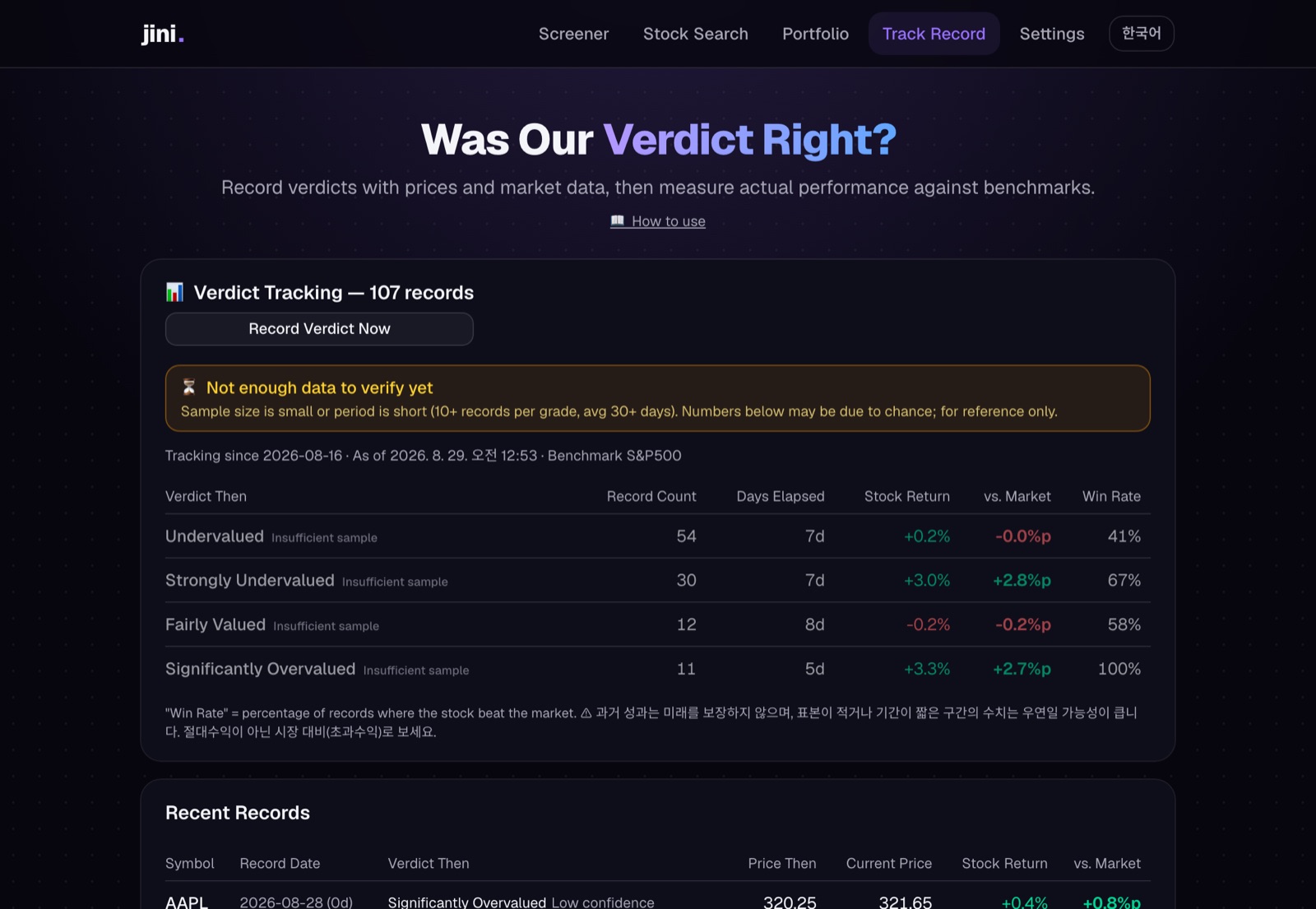 Tracking page — per-verdict aggregates and the small-sample warning
Tracking basics: record the verdict with its date
You find a candidate on the screener, open its stock page, and render a verdict. That verdict includes:
- Verdict level (Strong Undervalued through Significantly Overvalued)
- That day's stock price
- That day's S&P 500 index level
- Date recorded
All of this is saved by clicking [Record verdict today] or by nightly batch.
Later: tracking excess return
Time passes. Real price movement happens. jini:
- Tracks the current stock price
- Tracks the S&P 500 return
- Calculates:
Excess return (%) = (stock return) - (S&P 500 return)
Example:
- Day recorded: stock $100, S&P 500 index 4,000
- 30 days later: stock $110 (+10%), S&P 500 index 4,200 (+5%)
- Excess return: +10% − 5% = +5% beat
If stock is only $105 (+5%) but S&P 500 is +10%:
- Excess return: +5% − 10% = −5% miss
Verdict accuracy report
From the tracking page:
| Verdict level | Samples | Avg excess return | Confidence |
|---|---|---|---|
| Strong Undervalued | 8 | +2.3% | Low ⚠ |
| Undervalued | 24 | +1.1% | Low ⚠ |
| Fair Value | 15 | −0.2% | Low ⚠ |
| Overvalued | 5 | −3.5% | Low ⚠ |
Key: if sample size is small, a warning appears first: "Not yet ready to verify".
Sample requirements
jini considers a result statistically meaningful only if:
- At least 10 verdicts per level
- Average holding period of 30+ days
If unmet, "statistically, we cannot yet draw a reliable conclusion" appears before any number.
Why:
- 5 samples → luck plays too big a role
- 5-day hold → does not reflect real investment cycles (months to years)
Trade log tracking (optional)
Another section on the tracking page: [Trade log]
Enter actual buys and sells, and you get:
- Purchase price and date
- jini's verdict that day (what did it say when you bought?)
- Subsequent excess return
This answers: "If I followed jini's verdicts, how much did I actually make?"
Example:
- 2026-06-15: AAPL Strong Undervalued verdict → buy at $150
- 2026-08-15: now $165 (+10%), S&P 500 +6%
- Excess return: +4%p
- (Without a trade log entry, this is not recorded)
Why no historical backtest
"Did jini's screener work in the past?" is a natural question. But jini intentionally does not provide backtests. Here is why:
1. Lookahead bias (future information leaks in)
Current financials in the database are current, rewritten values. Example:
- "2023 revenue" as recorded in 2024 is the final October 2024 number
- But in January 2024, only "2023 revenue forecast" was known
- Rerunning past verdicts requires "what was known then", not saved
So backtests inherently use future data to compute the past, producing results far better than reality.
2. Survivorship bias (dead companies missing)
The current database has only companies listed today. But:
- Firms that failed in the 2000 dot-com crash are gone
- Firms that failed in 2008 are gone
- Recently delisted firms are gone
Simulating "if we screened the past", only the survivors remain, inflating results.
3. The "fake good number" problem
Combine these two:
- Backtest on past data → uses future information (lookahead)
- Only current listers → excludes failures (survivorship)
- Result: looks like +20% annual return in the past
- Reality: followers then would have earned +5–8%
This is nearly fraudulent.
So how good is jini?
Instead, jini:
- ❌ Does not backtest
- ✅ Records from today forward and validates in real time
Current tracking:
- Strong Undervalued: +2.3% excess (8 samples, low confidence)
- Undervalued: +1.1% excess (24 samples, low confidence)
These numbers:
- Did not leak future data
- Did not drop dead companies
- Are what you can actually follow today
Samples are small, so confidence is low. But this is the most honest way.
Why trust it
jini's tracking earns trust because:
- Right and wrong verdicts stay visible — nothing is hidden or edited
- Small samples trigger warnings first — "luck still plays a role here" is stated honestly
- No fake-good backtest numbers — only real in-progress records count
- Excess return only — versus S&P 500, not absolute (rising tide lifts all boats)
This is why jini wants to be a "reference tool" for decisions, not a perfect prediction engine. Transparent and verifiable over flashy.
Now go find candidates and later track them.