What is margin of safety — why you discount more when confidence is low
Last updated: 2026-08-29
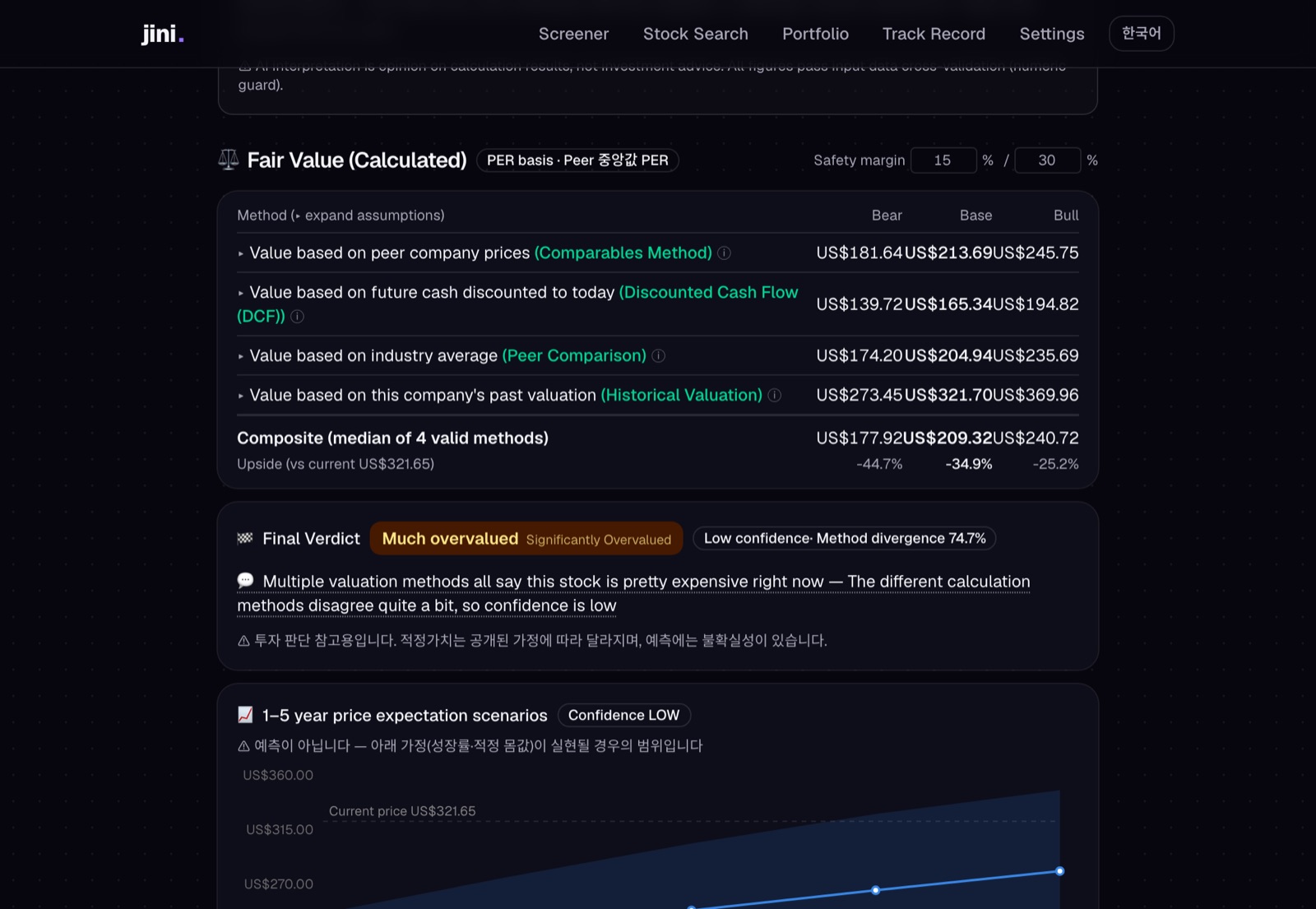 Fair value table (4 methods × scenarios), final verdict, and margin-of-safety inputs (top right)
The problem: calculated value is not truth
Step back and reconsider the fair value calculation. jini shows you a range from four methods:
Multiples:   13,000 ~ 17,000
DCF:         12,000 ~ 18,000
Peer:        14,500 ~ 16,500
Historical:  12,000 ~ 19,000

Consensus range: 12,000 ~ 19,000
Base estimate:   15,000
Now the stock trades at 14,000. Should you just buy because it's below fair value?
No. Because:
- Calculated value is still an estimate — shift the assumptions slightly and fair value moves dramatically
- Your real money is at stake — you need a buffer for when the calculation is wrong
- Lower confidence means bigger discount — the less sure you are, the more margin you need
That's the margin of safety.
Margin of safety: insurance against estimation error
Definition
Margin of safety = "I will only buy below a discounted price that's several percent below what I think fair value is"
Example:
Fair value: 15,000
15% margin of safety: 15,000 × 0.85 = 12,750 or less
30% margin of safety: 15,000 × 0.70 = 10,500 or less
That extra discount you demand (12,750–15,000 or 10,500–15,000) is your error buffer.
Why it matters
Imagine:
What I calculated as fair: 15,000
What fair value actually is: 12,000 (I missed a risk)
If you bought at 14,000 with zero margin of safety, you'd be overpaying by 16.7%.
If you only bought at 10,500 (30% margin), you'd have built in a 20% cushion against your miscalculation.
Investing is not about making money; it's about not losing it first. Margin of safety is that defense.
jini's defaults: 15% vs 30%
jini presents two margin settings:
| Margin | Scenario | Effect on verdict |
|---|---|---|
| 15% (default) | Medium confidence — methods mostly agree | Easier to get "undervalued" verdict |
| 30% (conservative) | Low confidence — methods scatter widely | Harder to get "undervalued" verdict |
When to use 15% (default)
1. All four methods give similar answers (confidence HIGH)
   Example: Multiples 15,200 / DCF 14,800 / Peer 15,100 / Historical 14,900

2. Business quality is strong (Quality score high)
   Growth, profitability, cash, and financial health all solid

3. Market expectations are reasonable (implied growth gap small or negative)
   No huge unanticipated growth priced in
Meet all three and a 15% buffer is enough.
When to raise to 30% (conservative)
1. Methods disagree sharply (confidence LOW)
   Example: Multiples 12,000 / DCF 18,000 / Peer 14,500 / Historical 16,500
   → 1.5x spread — which one do you trust?

2. Business quality is muddy
   Growth looks good but cash conversion weak, or debt rising

3. Market expectations are stretched (implied growth gap large and positive)
   → Market already pricing in above-consensus growth
In these cases, 30% margin lets you sleep at night.
How margin of safety connects to confidence
HIGH confidence (methods agree)
Fair value range: 14,500 ~ 15,500 (spread: 1,000)
Confidence: High
→ 15% margin enough: buy at 13,175 or below
→ "Undervalued" verdict comes through
When calculations tell the same story, error risk is low.
MEDIUM confidence (methods partially agree)
Fair value range: 13,000 ~ 17,000 (spread: 4,000)
Confidence: Medium
→ 15% margin: 13,775 / 30% margin: 11,900
→ Your choice: depends on how deep your research goes
Disagreement between methods → need bigger margin.
LOW confidence (methods all over the place)
Fair value range: 10,000 ~ 22,000 (spread: 12,000)
Confidence: Low
→ 15% margin: 18,700 / 30% margin: 15,400
→ Recommended: use 30% margin or sit it out
The less certain you are, the thicker your moat needs to be.
How to adjust margin of safety in jini
1. Margin input field on stock page
Look for the settings box on the right side of the fair value section:
┌──────────────────────────────┐
│ Margin of Safety Settings    │
│ ┌───────────────────────────┐│
│ │ Undervalued:   ⦿15%  ○30% ││
│ │ Strong Underv: ○15%  ⦿30% ││
│ └───────────────────────────┘│
└──────────────────────────────┘
Defaults are 15% and 30%, but you can click to change.
2. Change the margin and the verdict recalculates instantly
This is jini's secret weapon:
At 15% margin:
→ Entry price: 13,775
→ Current price: 14,000 > 13,775
→ Verdict: "UNDERVALUED"

At 30% margin:
→ Entry price: 10,500
→ Current price: 14,000 > 10,500
→ Verdict: "SIGNIFICANTLY OVERVALUED"
This is not a bug — it's a feature. It lets you test in real-time: "At my risk tolerance, would I buy this?"
3. What margin should I set? No single answer.
| Profile | Suggested margin | Reasoning |
|---|---|---|
| Aggressive | 15% | You've researched deeply and accept risk |
| Balanced | 20–25% | Most investors |
| Conservative | 30%+ | You're new, unsure, or capital-preservation focused |
You can use different margins for different stocks based on your confidence in each.
Common questions
Q: "Won't a 30% margin mean I can't buy anything?"
Yes, often. That means:
- The market is expensive — sitting in cash is the right move
- Wait for better odds — a margin that forces buying at 30% discount is the market telling you to wait
- Check multiple margins — "How many stocks pass at 15%, 20%, 30% margins?" Track it over time
Q: "Does a high margin = better stock?"
Close. High margin odds increase the likelihood it's a good stock because:
- Undervalued verdict has strict requirements → business quality is vetted
- Your error buffer is thick → mistakes hurt less
- Implied growth gap tends to be favorable → expectations are realistic
Q: "Can't I just use 15%?"
You can, if you check:
- Confidence HIGH (methods agree)?
- Business quality score ≥ 70?
- Implied growth gap zero or negative?
All yes? 15% is fine.
The bottom line: margin of safety is humility quantified
"Even if I calculated perfectly, the world can surprise me. So I demand a discount below my fair value estimate."
That's Benjamin Graham's margin of safety principle, and jini follows it.
- High confidence? → 15% margin is okay
- Low confidence? → Use 30% or more
- Still unsure? → Raise the margin or skip the stock
The beauty: in jini, you can change this setting instantly. Your risk tolerance shifts, your verdict shifts with it.
How to decide your personal margin of safety is explored in Turning numbers into a strategy.