Verdict Criteria — The 5 Levels and What Confidence Means
Last updated: 2026-08-29
jini's verdict is not a fixed opinion — it's a function of your risk tolerance. Adjust your safety margin and the verdict recalculates instantly. Miss a quality threshold and the system automatically downgrades the rating. The verdict is yours to dial in.
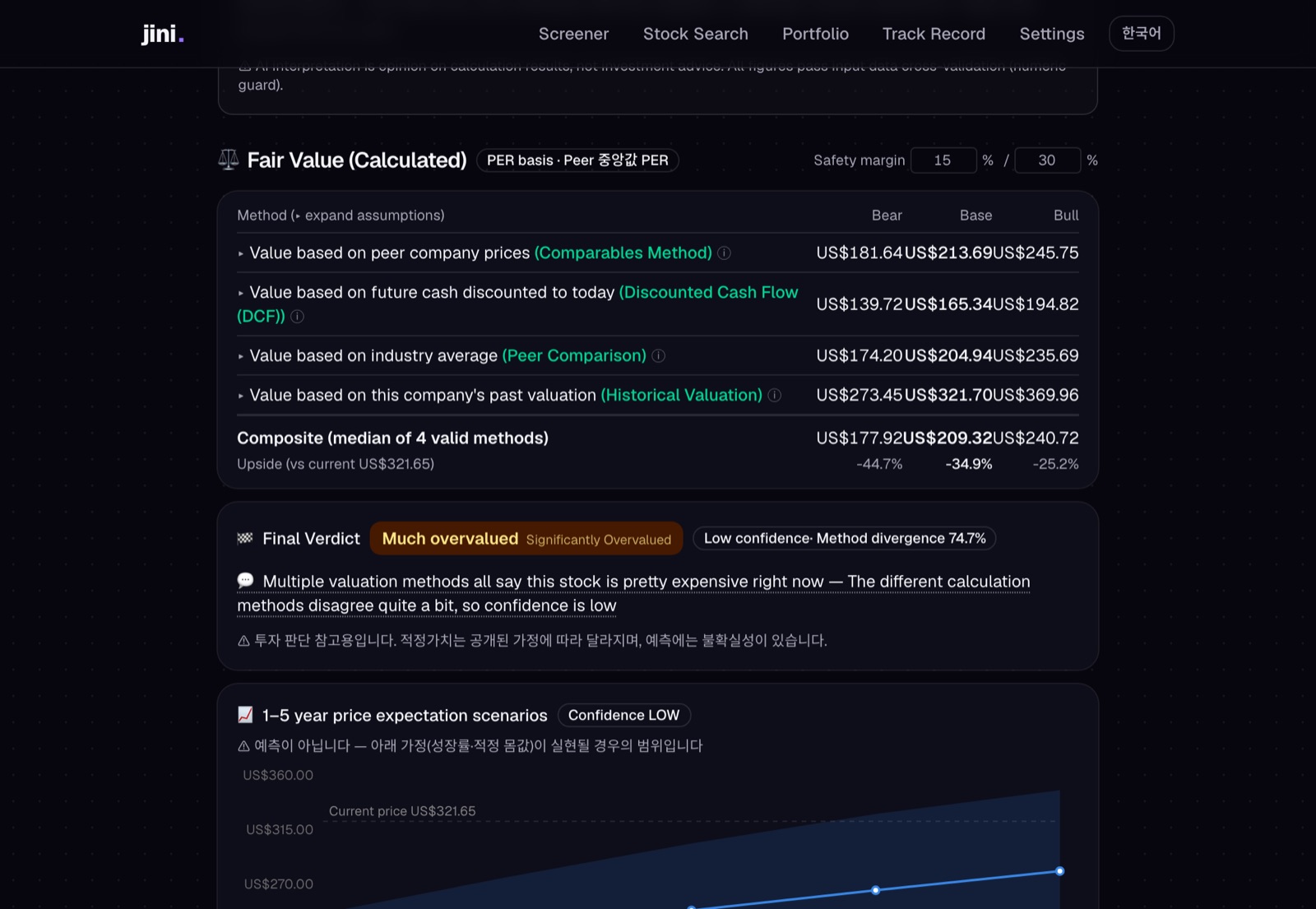 Fair value table (4 methods × scenarios), final verdict, and margin-of-safety inputs (top right)
The 5-Level Verdict
Your upside (fair value ÷ price − 1) maps directly to five categories:
| Verdict | Upside (default) | Meaning |
|---|---|---|
| Strong Undervalued | ≥30% | Worth close study — compelling price |
| Undervalued | ≥15% | Reasonable price — consider a position |
| Fairly Valued | −15% to +15% | Market has it right — limited margin of safety |
| Overvalued | ≤−15% | High expectations baked in — avoid buying |
| Significantly Overvalued | ≤−30% | Dangerous valuation — strong avoid |
Upside is simple math: if fair value is $30 and price is $20, upside is 50%.
Safety Margin — Your Threshold, Your Verdict
The 15%/30% numbers above are just defaults. Every stock page has a slider. Move it and the verdict recalculates in real time:
Adjust the margin:
  Undervalued: 15% → 20%
  Strong Undervalued: 30% → 40%

Result: a stock with 18% upside shifts from
"Undervalued" to "Fairly Valued"
This is core to jini's design. Your verdict is not set in stone — it's a live function of how much upside you require before you'll call something cheap.
What margin means
- 15% margin: A true risk-taker; 15% upside is enough to be "undervalued"
- 30% margin: Conservative; only 30%+ upside counts as "undervalued"
- 50% margin: Very cautious; only extreme bargains count
Set your margin and jini recalculates. This is not a company rating — it's your personal valuation template.
Confidence: How Sure Are We?
Two "undervalued" verdicts aren't created equal. One might rest on solid consensus across all four valuation methods. The other might be driven by a single outlier. That's what confidence levels capture:
| Level | Meaning |
|---|---|
| HIGH | 3 or more methods agree (dispersion ≤30%) |
| MEDIUM | 2+ methods mostly align (dispersion ≤60%) |
| LOW | Serious disagreement among methods (dispersion >60%) |
LOW confidence is a red flag. Example:
Stock: 40% upside (undervalued), but confidence is LOW

Breakdown:
  Multiples: Fair value $20 (−50% vs price)
  DCF: Fair value $35 (neutral)
  Peer: Fair value $30 (−20%)
  Historical: Fair value $28 (−10%)

Diagnosis: Only multiples method sees steep undervaluation.
The other three disagree. Use the verdict cautiously.
The page shows the actual dispersion number (e.g., "45% variance") so you can see why confidence is low.
Five Safeguards Against False Positives (Automatic Downgrades)
Just because a stock looks cheap by one metric doesn't mean it's undervalued. jini checks five gates before confirming an "undervalued" verdict. Fail any gate and the verdict steps down one level (max 2 steps):
Gate 1: Quality Score Must Exceed 45
"Cheap stocks are cheap for a reason." If the business is deteriorating (quality score <45), it's not undervalued — it's a trap.
Example: P/E of 8 (looks cheap) + Quality Score 30 (declining business) → Downgrade to "Fairly Valued"
Gate 2: Financial Health Must Exceed 40
High debt + weak liquidity = a cheap price hiding serious risk. A stock with 50% upside loses that appeal if the company can't service its debt.
Example: 50% upside + Debt/Equity 300% → Downgraded for financial risk
Gate 3: Type D/E High Confidence Triggers Automatic Downgrade
We'll cover this in the company types guide. Value Trap (Type D) and Cyclical Trap (Type E) classifications, when high-confidence, override an otherwise bullish valuation.
Example: AI flags Type D (value trap) with HIGH confidence → Downgrade even if metrics say undervalued
Gate 4: Bear Case Must Not Exceed −30% Downside
If even in a reasonable downside scenario the stock could fall 30%+, the downside risk outweighs the upside. The margin of safety vanishes.
Example: 30% base upside, but −40% in bear case → Downgraded for skewed risk/reward
Gate 5: Methods Must Substantially Agree
This is the confidence gate. If methods are in serious disagreement (confidence LOW), the verdict is downgraded.
Example: Half the methods bullish, half bearish → Downgrade to reflect uncertainty
Reading a Downgraded Verdict
On the screen:
🟡 Verdict: Undervalued (downgraded: low quality)

Raw rating: Strong Undervalued
Downgrade reason: Quality Score 40 < 45
Final verdict: Undervalued
Translation: "By the numbers it's strong undervalued, but the business is weak, so we're toning it down to undervalued."
"Withheld" Verdicts
Sometimes jini can't issue a verdict at all:
- Fewer than 2 valid methods: jini refuses single-method verdicts
- Current price is missing: Can't calculate upside
When this happens, you see the calculation results but no final verdict. It's honesty: "Not enough confidence to judge."
The Verdict as a Formula
Verdict = f(upside, quality, financial health, type, method agreement)
Every input is visible. You control the upside threshold (safety margin). The system checks quality, debt, and type automatically. And method agreement is shown as a dispersion number.
When you slide your safety margin from 15% to 25%, that's the only change in the formula — and the verdict recalculates to reflect it. That's why jini calls itself decision material, not a recommendation. The verdict is yours to dial.
Next: Company Types and Traps
Some downgrade triggers depend on what kind of company it is. A temporary earnings miss (Type B) is different from a structural value trap (Type D). Understanding the company's undervaluation type is half the judgment. Read Company Types next.